Project Description
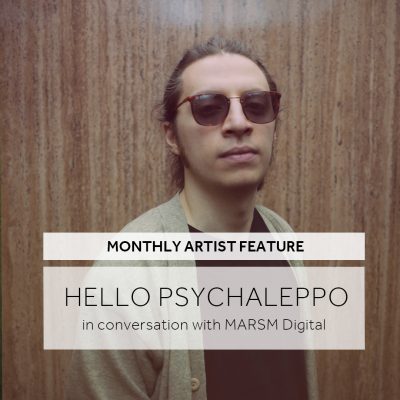
Artist Feature: Hello Psychaleppo
Artist Feature: Hello Psychaleppo
Electro-Tarab: Electrifying a Century-old Arabic Tradition
Electro-Tarab: Electrifying a Century-old Arabic Tradition
“What is it that you actually do?” was a question that producer and audio-visual artist Samer Saem Eldahr (aka Psychaleppo) took many years to be able to answer. Now recognised as a leading figure in the development of the electronic music scene, Samer admits that his first show was an improvised attempt at piecing together his ever-growing fascination with something that had, frankly, yet to be named.
Over a decade later, he seems to have it figured out. A regional reference point for peer producers, Psychaleppo has become a celebrated pioneer of Electro-Tarab, an electronified music genre which repositions Tarab, a cornerstone of Arabic musical culture and traditions, within the medium of electronic music. What makes his sound even more riveting is that he created his own tools to do so, something he still seems quite humble about.
The roots of Tarab in Psychaleppo’s music
An undeniable feature of Arabic music and history, Tarab draws its strength from the transcending power of the human voice, intonation and emotion (for more on Tarab, check out articles from The New Yorker and Anthrosource). Vital to this is the role of maqam, an intricate system of scales and modes fundamental to Arabic music which contribute to its distinct sound, texture and moods. Not specifically a genre and not easily translated in English, Tarab can therefore be better understood as encapsulating a state reached between performers and audiences; a synergy that connects and elevates us beyond our daily realm, often taking place in intimate spaces over the course of several hours.
In Samer’s musical realm, Tarab would ultimately become the medium for his unnamed musical mission. Growing up with, and influenced by, the rich musical tradition of Tarab, he saw no reason why courtyards and cafes couldn’t be swapped for clubs and venues, live vocals for remixed samples and backdrops amplified with his audio-visual projections. Seeing the potential for electronic club music to provide a new context for Tarab traditions, he aimed to recreate the elevated state of emotional and creative unity through music, performance, electronica and a good dose of his own creativity.
Yet with limited tools and a music industry geared to western sounds and cadences, how does one start playing Arab sounds out of synthesisers tuned to the West? How can this popular performance dynamic be recreated in a contemporary format? And ultimately, how do you win over audiences with something they’ve never heard before?
Bring it on, thought Samer.
Early Beginnings
Beginning his training in music theory and some classical Arabic music in Waltz in his hometown of Aleppo, Syria in his pre-teens, Samer understood the nuances and phrasing of Tarab melodies and maqam structures. Later, with a basic set-up, Samer began experimenting with samples of this music and played the keyboard in several rock bands with friends and local musicians (with a slightly embarrassed grin he makes it clear he’s not too keen to show us these tracks). These experiences meant he was familiar with the dynamic of performance, audience interaction and live concerts, providing him with a strong foundation for his theory and practice, and a robust resource that would become the backdrop of his later creations.
In 2012, Samer was invited to play his first show, invited by the Beiruti venue Metro Al Madina. With an obscure SoundCloud profile of 80 followers, and barely enough equipment to pull off a live show, he took on the challenge and quickly began preparing his upcoming set. Little did he know it would be the start of something much bigger. After the show, Samer was uncertain as to how it was received by the audience, but the venue invited him back: a vote of confidence that wasn’t lost on the budding performer. Conscious of this unique opportunity, Samer postponed the offer for eight months and took this time to create a solid piece of work. Ultimately, his first show at Al Madina encouraged him to lay the foundations of his first album ‘Gool L’ah’ which he released in 2013 and debuted at his second show. A few days before the official album release, he posted one of the album’s singles ‘Tarab Dub’ on SoundCloud, waking up to the delightful news that it was playing on Italian radio less than 24 hours later. He knew he was on the right track. To this day, Samer is deeply grateful to this venue and its organisers for their continued support and being a crucial stepping stone in his career. To date it has become his most-played venue; he tells us he has lost count of how many shows he has played there.
“One thing led to another and that’s how I got to where I am now”
It was only with the creation of his second and third album that Samer began to think consciously of his music as ‘Electro-Tarab’. Before that, it was simply a matter of putting “all his ideas and thoughts in one place”. As he amassed more synthesizers and equipment, he became engrossed in the process, fascinated by the technical challenges of his new genre. Yet, he recognised the limitations of the tools he was using and the challenge of making Arabic electronic music, especially with programs and instruments conceived within western musical frameworks. A particular challenge was the question of how to play quarter tones and their intonations (a key element of maqam) on keyboards that were, metaphorically speaking, monolingual. While he discovered hacks and new software to apply maqam to electronically produced music, he knew he would still have to think outside the box.
Electrifying a century-old tradition
If there was one thing Samer knew from the start it was that he needed to fully understand how his equipment worked before he could manipulate it the way he needed. Only a very small number of synthesisers have the ability and feature to be detuned and even the ones capable of playing Arabic scales require countless hours of reading manuals and fiddling around. So that’s exactly what Samer did. As a result, many of his early years as an artist were spent reprogramming instruments and experimenting with software and plug-ins. Yet even once he began to understand how to physically programme them, he was faced with his second challenge – how do you play on them? Samer endlessly trawled the web researching maqam, Tarab dynamics, vocal samples and synth tutorials. One of his biggest influences, he reflects, was Moroccan synth player and teacher Abdou El Omari whose early instrumental works greatly shaped the way he approached the synth.
Live shows
Things have gone a long way since that first Beirut show. Although the process has become easier, Samer still learns from every show and insists that the live performances are a key component of the creative process. Without them, there would be no creative feedback loop to guide him in arranging and improving his sets.
Mirroring the dynamic of traditional Tarab concerts, Samer appreciates the unique relationships that emerge between him and his audiences. Throughout his sets (which can span several hours) he feels he “becomes one with the audience” as their reactions affirm that this – making this kind of music to these people – is what he was meant to do. To him, music has never been a secondary thing and is instead the most direct form and extension of his expression. Yet before that moment can be reached, a lot of hard work goes in. Samer admits that the actual process of putting sounds together is only 30% of what he does, the other 70% being research, reviewing maqam sounds, discovering samples, finding the right formula and designing visual programs.
A talented artist, Samer also experiments with graphics and visual effects to create extraordinary posters and live moving images generated by the music itself. As with everything else in Samer’s musical journey, this is something he figured out himself. To programme the projection and audio-visual software, he lets his music ‘speak for itself’ by translating musical data into visuals. If a bass drum or snare is playing, a particular visual effect is triggered, and the models, shapes and landscapes he created would morph to the beat. Using this method, he is currently working on a music video called Makana (“machine” in Arabic), an exciting new project commission by the Arab American National Museum in Michigan and due to be released later this year.
Ultimately, Samer insists that it is hard to truly understand and grasp his music until it is experienced live – to this, we encourage everyone to follow his work and keep your eyes peeled for the next time he’s playing in a city near you!